


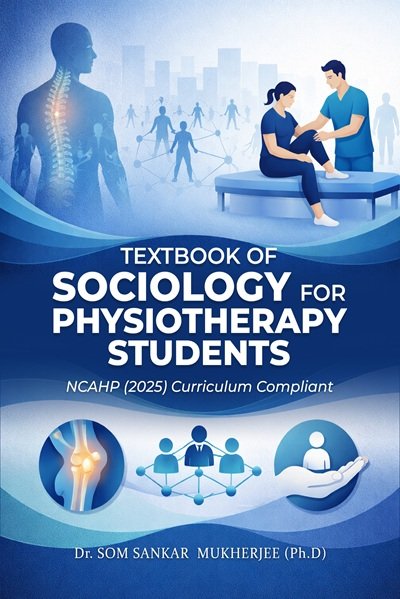
Textbook of Sociology for Physiotherapy Students: NCAHP (2025) Curriculum Compliant
₹499.00
- By: Dr. Som sankar Mukherjee (Ph.D)
- ISBN: 9789376862016
- Price: 499/-
- Page: 191
- Size: 8×11
- Category: EDUCATION / General
- Language: English
- Delivery Time: 07-09 Days
Description
About The Book
It gives us immense pleasure to present this textbook on Sociology for Bachelor of Physiotherapy (BPT) students, meticulously designed in alignment with the curriculum guidelines set forth by the National Commission for Allied and Health Professions (NCAHP), India. The field of physiotherapy is no longer limited to understanding anatomy, physiology, or therapeutic interventions in isolation; modern healthcare emphasizes a holistic approach, recognizing the patient as a social, cultural, and psychological being. In this context, sociology becomes an indispensable subject, enabling physiotherapy professionals to provide care that is not only clinically effective but also socially and culturally sensitive.
Sociology, by definition, is the scientific study of human society, social relationships, and the patterns of interaction that shape individual and collective behavior. For physiotherapy students, the study of sociology provides a framework to understand how social factors—such as family dynamics, community norms, socio-economic status, education, occupation, and cultural beliefs—impact health, illness, and recovery. It equips future physiotherapists with the skills to assess not just the physical, but also the social determinants of health, facilitating the delivery of patient-centered and contextually relevant care.
This textbook has been organized to offer a progressive learning experience, beginning with foundational concepts such as society, social structure, culture, socialization, and social institutions. It then explores the intersection of sociology with health and healthcare delivery, addressing topics like health disparities, social determinants of health, patient behavior, communication in healthcare, community health, and the role of physiotherapists in multidisciplinary care teams. Each chapter is designed to blend theory with practice, including case studies, real-life examples, and reflective exercises that encourage students to think critically about.
About The Author
Somsankar Mukherjee is a distinguished author, editor, and academic leader in the field of physiotherapy. Currently serving as the Chairperson of the Arunachal Pradesh Allied and Healthcare Council (2025–27), he has previously held the position of Professor and Head of the Department of Physiotherapy at Indira Gandhi Technological and Medical Sciences University (IGTAMSU), Ziro, Arunachal Pradesh (2017–2025). His international exposure includes a tenure as Lecturer and Sports Physiotherapist in the Department of Sports Sciences at Mekelle University, Tigray, Ethiopia (2012–2016). Dr. Mukherjee holds a Master of Physiotherapy (MPT) with specialization in Sports Physiotherapy and a PhD in Physiotherapy, reflecting a robust blend of clinical expertise and academic scholarship.
Dr. Mukherjee’s research contributions focus on evidence-based rehabilitation, sports injuries, and physiotherapy education. He has extensively explored clinical interventions such as comparative studies on static stretch versus muscle energy techniques for hamstring flexibility and the efficacy of Pilates for low back pain. His scholarly work also emphasizes physiotherapy pedagogy, applying frameworks like Bloom’s Taxonomy and Schön’s Reflective Model to enhance clinical reasoning and curriculum design. Additionally, he has conducted community health surveys assessing the interplay between livelihood, education, and awareness of non-communicable diseases among youth, reflecting a commitment to public health and preventive care.
As an accomplished author and editor, Dr. Mukherjee has contributed to numerous academic texts and research papers widely referenced in physiotherapy education and training. His publications underscore his expertise in sports rehabilitation, curriculum development, and evidence-based clinical practice, making him a recognized thought leader in his field.



Reviews
There are no reviews yet.