

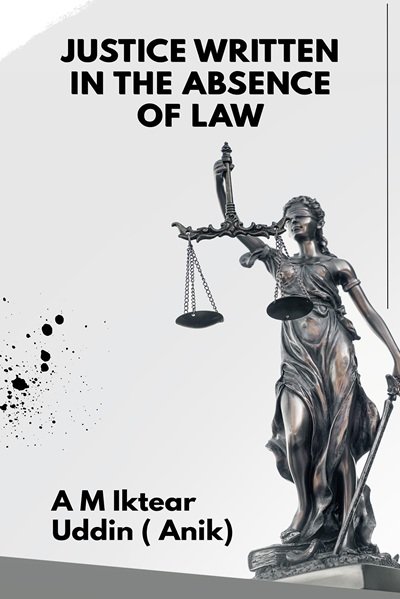
Justice Written in the Absence of Law (Paperback)
₹299.00
- By: A M Iktear Uddin (Anik)
- ISBN: 9789376861231
- Price: 299/-
- Page: 193
- Size: 5×8
- Category: LAW / General
- Language: English
- Delivery Time: 07-09 Days
Description
About The Book
Constitutions limit authority. However, there exist institutions that are prepared and capable of enforcing the constitution, rather than the words themselves. This is something that every generation learns. One of these bodies, judicial review, is extremely significant. It represents the idea that the rule of law takes precedence over authority and that even the most powerful branches of government must explain their acts in a legal and constitutionally sound manner.
That concept is currently under increased scrutiny. Governments now have monitoring technology that were previously unimaginable. Artificial intelligence is having an increasing impact on how governments make decisions. Climate change makes us consider what is fair to future generations and what governments should do for their citizens and the world. At the same time, civilisations are becoming more interconnected, and civil discussions in one location frequently have an impact on what occurs in another. Courts are sometimes required to uphold constitutional guarantees that are difficult to understand or significant.
This book covers the story of judicial review and the ideals that drive it forward. The story begins with the philosophical underpinnings of natural law and constitutional thinking. It then discusses the institutional breakthrough brought about by the Marbury v. Madison ruling in the early 1800s. The concept of judicial review spread to other legal systems in various ways. Following the Second World War, various countries, primarily in Europe established powerful constitutional courts. Others, such as India and South Africa developed their own traditions that expanded the scope of constitutional law to cover issues such as public interest litigation and socioeconomic rights. All of these examples demonstrate that judicial review is a set of evolving rules that are influenced by the political and historical circumstances of each area.
Along the way, the book examines the key ideas that have inspired debates concerning constitutional law. For many centuries, the concepts of judicial review have been formed by issues such as proportionality, constitutional supremacy, the “counter-majoritarian difficulty”, and the separation of powers. These debates are not limited to education. They have an impact on how courts interpret rights, how legislatures respond to court rulings and how people perceive the legitimacy of constitutional governments.
Just as important, the book examines how court review is evolving to address new issues. Today’s courts must deal with situations involving digital eavesdropping, welfare rights, environmental protection, and algorithmic choice with constitutional ideals in areas where scientific uncertainty and global interdependence make it difficult to apply traditional legal thought. The evolution of judicial review in these areas demonstrates its virtues as well as its faults.
The purpose of this work is not simply to explain a legal idea. Instead, this study attempts to consider judicial review as a dynamic institution that has evolved in tandem with politics, society, and our perceptions of what is right and fair. The book aims to provide readers with a clear picture of how constitutional systems attempt to hold authority accountable by examining their historical development, theoretical basis, and present applications.
Understanding how judicial review works is becoming increasingly important to legislators, judges, scholars, and concerned people. A constitutional democracy requires more than simply elections and legislation. It also needs organisations that can defend the rule of law when political pressure increases. In all of its manifestations, judicial review remains one of these bodies’ most vital functions.
If a society’s constitution outlines its most significant commitments, court review determines whether those promises are being kept. This question is more relevant than ever in a world where technology evolves swiftly, the environment is uncertain, and politics are always shifting.
About The Author
Advocate Anik M Iktear Uddin is link between old-fashioned lawsuits and new business ideas. He has been heading the legal team for many corporates and practising litigation before various courts across India for more than 17 years, and he is a powerhouse in civil, corporate, consumer, family, and criminal law and cybercrime litigation. He has an LL.M. from Bangalore University and is a second-rank holder. He mentors many startups and is the special public prosecutor on many heinous crime cases. He is a well-known legal and law enforcement strategist in India, and he received many awards from different state police departments for his remarkable contribution to different cases. His cases are featured at a true crime anthology series known as Crime Petrol – Hello Cabs. He has written multiples books on cyber crime, family law, property law.


Reviews
There are no reviews yet.