
Third World War is Highly Unlikely (The Long Peace: Why Global War is Obsolete)
₹380.00
- By: Prof Dr Lalith Kumar Dharavath
- ISBN: 9789376866632
- Price: 380/-
- Page: 187
- Size: 6×9
- Category: POLITICAL SCIENCE / General
- Language: English
- Delivery Time: 07-09 Days
Description
About The Book
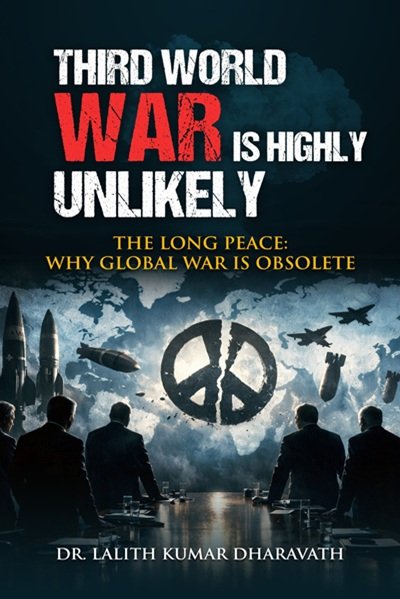
A third world war is deemed obsolete due to an “Architecture of Stability” comprising automated nuclear deterrence, deep economic interdependence, and non-aligned diplomacy. Conflict has shifted from territorial warfare to a “Grey Zone” of cyber and economic competition, where digital integration makes large-scale physical conflict functionally impossible. For further analysis on India’s role in this landscape. For nearly a century, the spectre of a Third World War has haunted the collective imagination. From the dawn of the atomic age to the digital fractures of the 21st century, the assumption was often that human history would inevitably conclude in a final, globe-spanning conflagration. Yet, as we stand in 2026, a different reality has taken hold. The “Long Peace”—that unprecedented era of relative stability between major powers since 1945—has defied the skeptics. It has survived the Cold War, the collapse of empires, and the rise of disruptive technologies. This analysis, “The Long Peace: Why Global War is Obsolete,” explores the profound realization that a Third World War is no longer a strategic destiny, but a choice that has been rendered impossible by the very world we have built. This work examines the Architecture of Stability that holds our world together. It moves beyond the simple absence of war to explore the “Triple Lock” system—Physical, Material, and Psychological—that makes global conflict economically suicidal and militarily irrational. A central theme of this analysis is the emergence of India and the Global South as the new “Diplomatic Circuit Breakers.” In a world once threatened by a bipolar collapse, India’s rise as a “Vishwa Mitra” (Friend of the World) has provided a stabilizing weight, ensuring that competition remains managed and that the boardroom remains more powerful than the battlefield. We have not reached the “end of history” or the end of conflict. We have, however, reached a point where humanity has finally constructed a world that is too expensive to dismantle, too dangerous to disrupt, and too integrated to destroy. This is the story of how we learned to manage the peace, and why the “obsolete” nature of total war is humanity’s greatest modern achievement.
About The Author
Professor (Dr) Lalith Kumar Dharavath, born in 1959, is a distinguished Professor (Retd) of Public Administration at Osmania University, Hyderabad, Telangana, India, whose illustrious career encompasses teaching, pioneering research, academic administration, and advisory board stewardship. Prolific Author and writer, widely regarded among contemporary modern thinkers, he has, rendered substantial contribution to academia and governance through the successful completion of major research projects funded by UGC and ICSSR, New Delhi. He has mentored more than 25 PhD scholars and numerous M Phil. Candidate. while authoring over120 books, published more than 4o research articles, editing several scholarly, books, magazines and academic journals. As a respected member of multiple research journal editorial boards, he has actively Participate in and presented papers at numerous national and international conferences, seminars workshops, and webinars. He also the propounded of the Resilience Theory Tanda Gor Banjar and Reciprocity theory and Practice. Reflecting his innovative intellectual engagement with socio -administrative discourse, and in recognition of his enduring scholarly excellence, he has been the recipient of many prestigious awards and honours.
Related products
-
- Sale!
Reviews
There are no reviews yet.